A JSON-LD 1.1 processor, with support for the JSON-LD 1.0 processing mode. More...
Classes | |
| class | sourcemeta::core::JSONLDError |
| class | sourcemeta::core::JSONLDFragmentError |
| struct | sourcemeta::core::JSONLDEdge |
| struct | sourcemeta::core::JSONLDNode |
| struct | sourcemeta::core::JSONLDLiteral |
| struct | sourcemeta::core::JSONLDReference |
| struct | sourcemeta::core::JSONLDPromotion |
| struct | sourcemeta::core::JSONLDCollection |
| struct | sourcemeta::core::JSONLDDescriptor |
| struct | sourcemeta::core::JSONLDBasicAnnotation< PointerT > |
Typedefs | |
| using | sourcemeta::core::JSONLDResolver = std::function<std::optional<JSON>(JSON::StringView)> |
| template<typename PointerT> | |
| using | sourcemeta::core::JSONLDBasicAnnotationList = std::vector<JSONLDBasicAnnotation<PointerT>> |
| using | sourcemeta::core::JSONLDAnnotationList = JSONLDBasicAnnotationList<Pointer> |
| using | sourcemeta::core::JSONLDWeakAnnotationList = JSONLDBasicAnnotationList<WeakPointer> |
Enumerations | |
| enum class | sourcemeta::core::JSONLDVersion : std::uint8_t { JSONLDVersion::V1_0 , JSONLDVersion::V1_1 } |
| enum class | sourcemeta::core::JSONLDDirection : std::uint8_t { JSONLDDirection::LTR , JSONLDDirection::RTL } |
| enum class | sourcemeta::core::JSONLDContainer : std::uint8_t { JSONLDContainer::List , JSONLDContainer::Set , JSONLDContainer::Language , JSONLDContainer::Index } |
Functions | |
| SOURCEMETA_CORE_JSONLD_EXPORT auto | sourcemeta::core::jsonld_expand (const JSON &input, const JSON::StringView base_iri="", const JSONLDResolver &resolver={}, const JSONLDVersion version=JSONLDVersion::V1_1) -> JSON |
| SOURCEMETA_CORE_JSONLD_EXPORT auto | sourcemeta::core::jsonld_expand (const JSON &input, const JSON &expand_context, const JSON::StringView base_iri="", const JSONLDResolver &resolver={}, const JSONLDVersion version=JSONLDVersion::V1_1) -> JSON |
| SOURCEMETA_CORE_JSONLD_EXPORT auto | sourcemeta::core::jsonld_is_expanded (const JSON &document) -> bool |
| SOURCEMETA_CORE_JSONLD_EXPORT auto | sourcemeta::core::jsonld_compact (const JSON &input, const JSON &context, const JSON::StringView base_iri="", const JSONLDResolver &resolver={}, const JSONLDVersion version=JSONLDVersion::V1_1, const bool compact_arrays=true, const bool compact_to_relative=true) -> JSON |
| SOURCEMETA_CORE_JSONLD_EXPORT auto | sourcemeta::core::jsonld_flatten (const JSON &input) -> JSON |
| SOURCEMETA_CORE_JSONLD_EXPORT auto | sourcemeta::core::jsonld_flatten (const JSON &input, const JSON &context, const JSON::StringView base_iri="", const JSONLDResolver &resolver={}, const JSONLDVersion version=JSONLDVersion::V1_1, const bool compact_arrays=true) -> JSON |
| SOURCEMETA_CORE_JSONLD_EXPORT auto | sourcemeta::core::jsonld_materialize (const JSON &instance, const JSONLDAnnotationList &annotations) -> JSON |
| SOURCEMETA_CORE_JSONLD_EXPORT auto | sourcemeta::core::jsonld_materialize (const JSON &instance, const JSONLDWeakAnnotationList &annotations) -> JSON |
| SOURCEMETA_CORE_JSONLD_EXPORT auto | sourcemeta::core::jsonld_canonicalize_fragment (const JSON &fragment) -> JSON |
A JSON-LD 1.1 processor, with support for the JSON-LD 1.0 processing mode.
This functionality is included as follows:
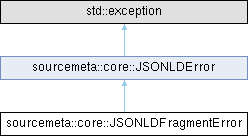
| class sourcemeta::core::JSONLDError |
An error that represents a JSON-LD processing failure. The message is one of the error codes defined by the JSON-LD 1.1 API specification, and the pointer locates the offending position in the input document
Public Member Functions | |
| JSONLDError (const char *code, Pointer pointer) | |
| Locate the error at an owned pointer. | |
| JSONLDError (const char *code, const WeakPointer &pointer) | |
| Locate the error at a weak pointer, materialising an owned pointer. | |
| JSONLDError (const char *code, const WeakPointer &pointer, const std::initializer_list< JSON::StringView > children) | |
|
inline |
Locate the error at a weak pointer extended with the given trailing property tokens.
| class sourcemeta::core::JSONLDFragmentError |
An error that represents a constants fragment grammar violation. The message states the violated fragment rule, the key names the offending fragment entry, and the pointer locates the offending value inside the fragment
Public Member Functions | |
| JSONLDFragmentError (const char *code, Pointer pointer, JSON::String key) | |
| Locate the error at a fragment entry. | |
| auto | key () const noexcept -> const JSON::String & |
| Public Member Functions inherited from sourcemeta::core::JSONLDError | |
| JSONLDError (const char *code, Pointer pointer) | |
| Locate the error at an owned pointer. | |
| JSONLDError (const char *code, const WeakPointer &pointer) | |
| Locate the error at a weak pointer, materialising an owned pointer. | |
| JSONLDError (const char *code, const WeakPointer &pointer, const std::initializer_list< JSON::StringView > children) | |
|
inlinenodiscardnoexcept |
Get the key of the fragment entry that caused the error, empty when the fragment itself is malformed
| struct sourcemeta::core::JSONLDEdge |
How a position connects to its parent. The position is the object of the edge, asserted in reverse when the flag is set.
Public Attributes | |
| JSON::String | predicate {} |
| The predicate that connects the position to its parent. | |
| bool | reverse {false} |
| Whether the edge is asserted in reverse. | |
| struct sourcemeta::core::JSONLDNode |
A position that is an object. An absent identifier means a fresh blank node, and the graph flag asserts the node's descendants in the named graph the identifier denotes.
Public Attributes | |
| std::optional< JSON::String > | id {} |
| The node identifier, absent for a fresh blank node. | |
| std::vector< JSON::String > | types {} |
| The types of the node. | |
| bool | graph {false} |
| Whether the node's descendants are asserted in the named graph it denotes. | |
| JSON | constants {JSON::make_object()} |
| JSON sourcemeta::core::JSONLDNode::constants {JSON::make_object()} |
Constant properties merged into the node, as a canonical fragment of predicate to term array whose entries are all non-empty term arrays, never null removal entries. May be empty.
| struct sourcemeta::core::JSONLDLiteral |
A position that is a value. The datatype defaults to the native type of the JSON value, a language may carry a direction, and the JSON flag preserves an opaque JSON literal verbatim.
Public Attributes | |
| std::optional< JSON::String > | datatype {} |
| std::optional< JSON::String > | language {} |
| The language tag of the literal. | |
| std::optional< JSONLDDirection > | direction {} |
| The base direction of the literal. | |
| bool | json {false} |
| Whether the literal is preserved as an opaque JSON literal. | |
| std::optional<JSON::String> sourcemeta::core::JSONLDLiteral::datatype {} |
The literal datatype, defaulting to the native type of the value. An explicit datatype carries a native number or boolean as its canonical string lexical form.
| struct sourcemeta::core::JSONLDReference |
A scalar promoted to an identified node
Public Attributes | |
| JSON::String | id {} |
| The identifier of the promoted node. | |
| std::vector< JSON::String > | types {} |
| The types of the promoted node. | |
| JSON | constants {JSON::make_object()} |
| JSON sourcemeta::core::JSONLDReference::constants {JSON::make_object()} |
Constant properties merged into the node, as a canonical fragment of predicate to term array whose entries are all non-empty term arrays, never null removal entries. May be empty.
| struct sourcemeta::core::JSONLDPromotion |
A scalar promoted to a node that carries the scalar as a literal under a value predicate, plus constant properties. A null value at a promoted position materializes nothing, as constant properties never appear without the scalar that legitimizes them.
Public Attributes | |
| std::optional< JSON::String > | id {} |
| The node identifier, absent for a fresh blank node. | |
| std::vector< JSON::String > | types {} |
| The types of the promoted node. | |
| JSON::String | value {} |
| The predicate that carries the scalar. | |
| JSONLDLiteral | literal {} |
| JSON | constants {JSON::make_object()} |
| JSON sourcemeta::core::JSONLDPromotion::constants {JSON::make_object()} |
Constant properties merged into the node, as a canonical fragment of predicate to term array whose entries are all non-empty term arrays, never null removal entries. May be empty.
| JSONLDLiteral sourcemeta::core::JSONLDPromotion::literal {} |
The literal facets of the carried scalar. The opaque JSON literal facet does not apply to a promoted scalar and must stay unset.
| struct sourcemeta::core::JSONLDCollection |
A position that is a collection. A List is asserted as an RDF list and a Set as a set, both ranging over an array. A Language container ranges over an object of language tag to string, and an Index container over an object whose keys are index labels that carry no RDF.
Public Attributes | |
| JSONLDContainer | container {JSONLDContainer::Set} |
| The container form of the collection. | |
| struct sourcemeta::core::JSONLDDescriptor |
The semantics of a single instance position: how it connects to its parent and what it is
Public Attributes | |
| std::vector< JSONLDEdge > | edges {} |
| How the position connects to its parent. | |
| std::variant< JSONLDNode, JSONLDLiteral, JSONLDReference, JSONLDCollection, JSONLDPromotion > | value {} |
| What the position is. | |
| struct sourcemeta::core::JSONLDBasicAnnotation |
An instance position paired with its JSON-LD semantics
Public Attributes | |
| JSONLDDescriptor | descriptor {} |
| The JSON-LD semantics of the position. | |
An annotation list whose positions are owning JSON Pointers
| using sourcemeta::core::JSONLDBasicAnnotationList = std::vector<JSONLDBasicAnnotation<PointerT>> |
A flat collection of annotated instance positions, in any order. When more than one entry describes the same position, the first one wins.
| using sourcemeta::core::JSONLDResolver = std::function<std::optional<JSON>(JSON::StringView)> |
A resolver callback for loading remote JSON-LD contexts referenced during expansion. Given an absolute IRI, it returns the referenced document, or no value if it cannot be resolved.
An annotation list whose positions are non-owning weak JSON Pointers. The positions reference strings owned elsewhere that must outlive any materialization call.
|
strong |
The container form of a collection position. List and Set range over an array; Language and Index range over an object.
|
strong |
|
strong |
| SOURCEMETA_CORE_JSONLD_EXPORT auto sourcemeta::core::jsonld_canonicalize_fragment | ( | const JSON & | fragment | ) | -> JSON |
Validate a fragment of constant node properties written in a restricted expanded form and return its canonical form: keys sorted, bare scalars and single terms wrapped into term arrays, duplicate terms removed, and native numbers or booleans paired with an explicit datatype rewritten to their canonical string lexical form. A grammar violation throws. A null entry passes through untouched as the caller's removal channel, so a canonical fragment only becomes usable as descriptor constants once the caller resolves removals and strips the null entries. For example:
| SOURCEMETA_CORE_JSONLD_EXPORT auto sourcemeta::core::jsonld_compact | ( | const JSON & | input, |
| const JSON & | context, | ||
| const JSON::StringView | base_iri = "", | ||
| const JSONLDResolver & | resolver = {}, | ||
| const JSONLDVersion | version = JSONLDVersion::V1_1, | ||
| const bool | compact_arrays = true, | ||
| const bool | compact_to_relative = true ) -> JSON |
Compact a JSON-LD document in expanded form against the given context to produce a friendlier shape. The input must already be expanded, and the result carries the given context. For example:
| SOURCEMETA_CORE_JSONLD_EXPORT auto sourcemeta::core::jsonld_expand | ( | const JSON & | input, |
| const JSON & | expand_context, | ||
| const JSON::StringView | base_iri = "", | ||
| const JSONLDResolver & | resolver = {}, | ||
| const JSONLDVersion | version = JSONLDVersion::V1_1 ) -> JSON |
Expand a JSON-LD document, applying the given expansion context before the document's own context, as if it had been prepended to the input. For example:
| SOURCEMETA_CORE_JSONLD_EXPORT auto sourcemeta::core::jsonld_expand | ( | const JSON & | input, |
| const JSON::StringView | base_iri = "", | ||
| const JSONLDResolver & | resolver = {}, | ||
| const JSONLDVersion | version = JSONLDVersion::V1_1 ) -> JSON |
Expand a JSON-LD document into its expanded form, resolving relative references against the given base IRI and loading any remote context through the given resolver. The result is always a JSON array. For example:
Flatten a JSON-LD document in expanded form, collecting the properties of each node into a single node object and labelling blank nodes. The input must already be expanded. For example:
| SOURCEMETA_CORE_JSONLD_EXPORT auto sourcemeta::core::jsonld_flatten | ( | const JSON & | input, |
| const JSON & | context, | ||
| const JSON::StringView | base_iri = "", | ||
| const JSONLDResolver & | resolver = {}, | ||
| const JSONLDVersion | version = JSONLDVersion::V1_1, | ||
| const bool | compact_arrays = true ) -> JSON |
Flatten a JSON-LD document in expanded form and compact the result against the given context. The input must already be expanded, and the result carries the given context. For example:
| SOURCEMETA_CORE_JSONLD_EXPORT auto sourcemeta::core::jsonld_is_expanded | ( | const JSON & | document | ) | -> bool |
Determine whether a document is in the JSON-LD 1.1 expanded document form: an array of node objects that carries no context and whose keys are all absolute IRIs, blank node identifiers, or keywords. For example:
| SOURCEMETA_CORE_JSONLD_EXPORT auto sourcemeta::core::jsonld_materialize | ( | const JSON & | instance, |
| const JSONLDAnnotationList & | annotations ) -> JSON |
Materialize an instance into expanded JSON-LD using an annotation list that assigns JSON-LD semantics to instance positions. An undescribed member of a collection defaults to a plain literal, or to a collection of the enclosing kind for a nested array. The result is always a JSON array. For example:
| SOURCEMETA_CORE_JSONLD_EXPORT auto sourcemeta::core::jsonld_materialize | ( | const JSON & | instance, |
| const JSONLDWeakAnnotationList & | annotations ) -> JSON |
Materialize an instance into expanded JSON-LD using a weak annotation list whose positions are non-owning views into strings owned elsewhere. The backing strings must outlive the call. An undescribed member of a collection defaults to a plain literal, or to a collection of the enclosing kind for a nested array. The result is always a JSON array. For example:
 1.16.1