A standards-driven implementation of the OpenID Connect 1.0 message family. More...
Functions | |
| SOURCEMETA_CORE_OIDC_EXPORT auto | sourcemeta::core::oidc_nonce () -> std::array< char, 43 > |
| SOURCEMETA_CORE_OIDC_EXPORT auto | sourcemeta::core::oidc_build_authentication_url (const std::string_view endpoint, const OIDCAuthenticationRequest &request, std::string &sink, const OIDCProfile profile=OIDCProfile::Strict) -> bool |
| SOURCEMETA_CORE_OIDC_EXPORT auto | sourcemeta::core::oidc_authorization_url (const std::string_view authorization_endpoint, const std::string_view client_id, const std::string_view redirect_uri, const std::string_view state, const std::string_view code_challenge, const std::string_view nonce) -> std::optional< std::string > |
| SOURCEMETA_CORE_OIDC_EXPORT auto | sourcemeta::core::oidc_parse_authentication_request (const std::string_view query, std::string &storage, OIDCAuthenticationRequest &result, const OIDCProfile profile=OIDCProfile::Strict) -> bool |
| SOURCEMETA_CORE_OIDC_EXPORT auto | sourcemeta::core::oidc_is_standard_claim (const std::string_view name) noexcept -> bool |
| SOURCEMETA_CORE_OIDC_EXPORT auto | sourcemeta::core::oidc_scope_to_claims (const std::string_view scopes, const std::function< void(std::string_view)> &on_claim) -> void |
| SOURCEMETA_CORE_OIDC_EXPORT auto | sourcemeta::core::oidc_claim_to_scope (const std::string_view claim) noexcept -> std::optional< std::string_view > |
| SOURCEMETA_CORE_OIDC_EXPORT auto | sourcemeta::core::oidc_build_claims_parameter (const std::span< const OIDCClaimRequest > userinfo_claims, const std::span< const OIDCClaimRequest > id_token_claims) -> JSON |
| SOURCEMETA_CORE_OIDC_EXPORT auto | sourcemeta::core::oidc_claims_parameter_requests (const JSON &claims, const std::string_view target, const std::string_view claim) -> bool |
| SOURCEMETA_CORE_OIDC_EXPORT auto | sourcemeta::core::oidc_claims_parameter_is_essential (const JSON &claims, const std::string_view target, const std::string_view claim) -> bool |
| SOURCEMETA_CORE_OIDC_EXPORT auto | sourcemeta::core::oidc_claims_parameter_value (const JSON &claims, const std::string_view target, const std::string_view claim) -> const JSON * |
| SOURCEMETA_CORE_OIDC_EXPORT auto | sourcemeta::core::oidc_claims_parameter_accepts (const JSON &claims, const std::string_view target, const std::string_view claim, const JSON &value) -> bool |
| SOURCEMETA_CORE_OIDC_EXPORT auto | sourcemeta::core::oidc_claim_request_accepts (const JSON &request, const JSON &value) -> bool |
| SOURCEMETA_CORE_OIDC_EXPORT auto | sourcemeta::core::oidc_claim_request_accepts_multi_valued (const JSON &request, const JSON &value) -> bool |
| SOURCEMETA_CORE_OIDC_EXPORT auto | sourcemeta::core::oidc_discovery_url (const std::string_view issuer) -> std::optional< std::string > |
| SOURCEMETA_CORE_OIDC_EXPORT auto | sourcemeta::core::oidc_webfinger_request (const std::string_view identifier) -> std::optional< OIDCWebFingerRequest > |
| SOURCEMETA_CORE_OIDC_EXPORT auto | sourcemeta::core::oidc_webfinger_issuer (const JSON &descriptor) -> std::optional< std::string_view > |
| SOURCEMETA_CORE_OIDC_EXPORT auto | sourcemeta::core::oidc_decrypt_nested_jwt (const std::string_view compact, const JWKPrivate &key) -> std::optional< std::string > |
| SOURCEMETA_CORE_OIDC_EXPORT auto | sourcemeta::core::oidc_error_code (const OIDCAuthenticationError error) noexcept -> std::string_view |
| SOURCEMETA_CORE_OIDC_EXPORT auto | sourcemeta::core::to_oidc_authentication_error (const std::string_view code) noexcept -> std::optional< OIDCAuthenticationError > |
| SOURCEMETA_CORE_OIDC_EXPORT auto | sourcemeta::core::oidc_token_hash (const std::string_view token, const JWSAlgorithm algorithm) -> std::optional< std::string > |
| SOURCEMETA_CORE_OIDC_EXPORT auto | sourcemeta::core::oidc_verify_token_hash (const std::string_view token, const JWSAlgorithm algorithm, const std::string_view claim) -> bool |
| SOURCEMETA_CORE_OIDC_EXPORT auto | sourcemeta::core::oidc_parse_id_token (const JSON &token_response) -> std::optional< std::string > |
| SOURCEMETA_CORE_OIDC_EXPORT auto | sourcemeta::core::oidc_validate_id_token (const JWT &token, const JWKS &keys, const std::span< const JWSAlgorithm > allowed_algorithms, const std::string_view issuer, const std::string_view client_id, const std::chrono::system_clock::time_point now, const OIDCValidationOptions &options={}, const JWTClockSkew clock_skew={}) -> std::optional< OIDCIdentity > |
| SOURCEMETA_CORE_OIDC_EXPORT auto | sourcemeta::core::oidc_validate_id_token (JWKSProvider &provider, const JWT &token, const std::span< const JWSAlgorithm > allowed_algorithms, const std::string_view issuer, const std::string_view client_id, const OIDCValidationOptions &options={}) -> std::optional< OIDCIdentity > |
| SOURCEMETA_CORE_OIDC_EXPORT auto | sourcemeta::core::oidc_mint_id_token (const OIDCIdTokenClaims &claims, const JWKPrivate &key, const JWSAlgorithm algorithm) -> std::optional< std::string > |
| SOURCEMETA_CORE_OIDC_EXPORT auto | sourcemeta::core::oidc_build_logout_url (const std::string_view end_session_endpoint, const OIDCLogoutRequest &request, std::string &sink) -> void |
| SOURCEMETA_CORE_OIDC_EXPORT auto | sourcemeta::core::oidc_validate_logout_token (const JWT &token, const JWKS &keys, const std::span< const JWSAlgorithm > allowed_algorithms, const std::string_view issuer, const std::string_view client_id, const std::chrono::system_clock::time_point now, const JWTClockSkew clock_skew={}) -> bool |
| SOURCEMETA_CORE_OIDC_EXPORT auto | sourcemeta::core::oidc_front_channel_pairing_is_valid (const std::string_view issuer, const std::string_view session_id) -> bool |
| SOURCEMETA_CORE_OIDC_EXPORT auto | sourcemeta::core::oidc_session_state (const std::string_view client_id, const std::string_view origin, const std::string_view provider_browser_state, const std::string_view salt) -> std::string |
| SOURCEMETA_CORE_OIDC_EXPORT auto | sourcemeta::core::oidc_make_provider_metadata (const OIDCProviderMetadataConfig &config) -> std::optional< JSON > |
| SOURCEMETA_CORE_OIDC_EXPORT auto | sourcemeta::core::oidc_sector_identifier_contains (const JSON §or_document, const std::span< const std::string_view > redirect_uris) -> bool |
| SOURCEMETA_CORE_OIDC_EXPORT auto | sourcemeta::core::oidc_request_object_pairing_is_valid (const std::string_view request, const std::string_view request_uri) -> bool |
| SOURCEMETA_CORE_OIDC_EXPORT auto | sourcemeta::core::oidc_build_request_object (const JSON ¶meters, const JWKPrivate &key, const JWSAlgorithm algorithm) -> std::optional< std::string > |
| SOURCEMETA_CORE_OIDC_EXPORT auto | sourcemeta::core::oidc_verify_request_object (const JWT &token, const JWKS &keys, const std::span< const JWSAlgorithm > allowed_algorithms, const std::string_view client_id, const std::string_view provider_issuer) -> std::optional< JSON > |
| SOURCEMETA_CORE_OIDC_EXPORT auto | sourcemeta::core::oidc_subject_type_name (const OIDCSubjectType type) noexcept -> std::string_view |
| SOURCEMETA_CORE_OIDC_EXPORT auto | sourcemeta::core::to_oidc_subject_type (const std::string_view name) noexcept -> std::optional< OIDCSubjectType > |
| SOURCEMETA_CORE_OIDC_EXPORT auto | sourcemeta::core::oidc_pairwise_subject (const std::string_view sector_identifier, const std::string_view local_account_identifier, const std::string_view provider_secret) -> std::string |
| SOURCEMETA_CORE_OIDC_EXPORT auto | sourcemeta::core::oidc_build_userinfo (const std::string_view subject, const JSON &additional_claims) -> JSON |
| SOURCEMETA_CORE_OIDC_EXPORT auto | sourcemeta::core::oidc_userinfo_matches_subject (const JSON &userinfo, const std::string_view expected_subject) -> bool |
| SOURCEMETA_CORE_OIDC_EXPORT auto | sourcemeta::core::oidc_verify_userinfo (const JWT &token, const JWKS &keys, const std::span< const JWSAlgorithm > allowed_algorithms, const std::string_view expected_subject, const std::string_view expected_issuer, const std::string_view expected_client_id) -> std::optional< JSON > |
| SOURCEMETA_CORE_OIDC_EXPORT auto | sourcemeta::core::oidc_merge_claims (const JSON &id_token_claims, const JSON &userinfo) -> std::optional< JSON > |
A standards-driven implementation of the OpenID Connect 1.0 message family.
This functionality is included as follows:
| struct sourcemeta::core::OIDCAuthenticationRequest |
An OpenID Connect authentication request, the OAuth authorization request extended with the OpenID Connect parameters (OpenID Connect Core 1.0 Section 3.1.2.1). Each field is a non-owning view.
Public Attributes | |
| std::string_view | client_id |
| The client identifier (OpenID Connect Core 1.0 Section 3.1.2.1), REQUIRED. | |
| std::string_view | redirect_uri |
| The redirection URI (OpenID Connect Core 1.0 Section 3.1.2.1), REQUIRED. | |
| std::string_view | scope |
| std::string_view | response_type |
| std::string_view | state |
| The opaque CSRF state value (OpenID Connect Core 1.0 Section 3.1.2.1). | |
| std::string_view | code_challenge |
| The PKCE code challenge (RFC 7636 Section 4.3). | |
| std::string_view | code_challenge_method |
| The PKCE code challenge method (RFC 7636 Section 4.3). | |
| std::string_view | nonce |
| std::string_view | display |
| std::string_view | prompt |
| std::string_view | max_age |
| std::string_view | ui_locales |
| std::string_view | id_token_hint |
| std::string_view | login_hint |
| std::string_view | acr_values |
| std::string_view | claims |
| std::string_view | request |
| std::string_view | request_uri |
| std::string_view | response_mode |
| std::string_view sourcemeta::core::OIDCAuthenticationRequest::acr_values |
The space-delimited requested authentication context class references (OpenID Connect Core 1.0 Section 3.1.2.1).
| std::string_view sourcemeta::core::OIDCAuthenticationRequest::claims |
The serialized claims request parameter (OpenID Connect Core 1.0 Section 5.5).
| std::string_view sourcemeta::core::OIDCAuthenticationRequest::display |
How the provider displays the authentication interface (OpenID Connect Core 1.0 Section 3.1.2.1).
| std::string_view sourcemeta::core::OIDCAuthenticationRequest::id_token_hint |
The ID Token previously issued, hinting the session (OpenID Connect Core 1.0 Section 3.1.2.1).
| std::string_view sourcemeta::core::OIDCAuthenticationRequest::login_hint |
A hint about the login identifier (OpenID Connect Core 1.0 Section 3.1.2.1).
| std::string_view sourcemeta::core::OIDCAuthenticationRequest::max_age |
The maximum authentication age in seconds (OpenID Connect Core 1.0 Section 3.1.2.1).
| std::string_view sourcemeta::core::OIDCAuthenticationRequest::nonce |
The string bound to the session and returned in the ID Token (OpenID Connect Core 1.0 Section 3.1.2.1).
| std::string_view sourcemeta::core::OIDCAuthenticationRequest::prompt |
The space-delimited prompt values, where none must appear alone (OpenID Connect Core 1.0 Section 3.1.2.1).
| std::string_view sourcemeta::core::OIDCAuthenticationRequest::request |
The request object carried by value as a signed JWT (OpenID Connect Core 1.0 Section 6.1).
| std::string_view sourcemeta::core::OIDCAuthenticationRequest::request_uri |
The request object carried by reference (OpenID Connect Core 1.0 Section 6.2).
| std::string_view sourcemeta::core::OIDCAuthenticationRequest::response_mode |
The response mode override (OAuth 2.0 Multiple Response Type Encoding Practices).
| std::string_view sourcemeta::core::OIDCAuthenticationRequest::response_type |
The response type, defaulting to code (OpenID Connect Core 1.0 Section 3.1.2.1).
| std::string_view sourcemeta::core::OIDCAuthenticationRequest::scope |
The space-delimited scope, which must contain openid (OpenID Connect Core 1.0 Section 3.1.2.1), REQUIRED.
| std::string_view sourcemeta::core::OIDCAuthenticationRequest::ui_locales |
The space-delimited preferred UI locales (OpenID Connect Core 1.0 Section 3.1.2.1).
| struct sourcemeta::core::OIDCClaimRequest |
A claim requested through the claims request parameter (OpenID Connect Core 1.0 Section 5.5).
Public Attributes | |
| std::string_view | name |
| The requested claim name. | |
| bool | essential {false} |
| Whether the claim is essential (OpenID Connect Core 1.0 Section 5.5.1). | |
| const JSON * | value {nullptr} |
| std::span< const JSON > | values {} |
| const JSON* sourcemeta::core::OIDCClaimRequest::value {nullptr} |
A specific value the claim is requested to have, or no value (OpenID Connect Core 1.0 Section 5.5.1).
| std::span<const JSON> sourcemeta::core::OIDCClaimRequest::values {} |
A set of values the claim is requested to have one of, in order of preference (OpenID Connect Core 1.0 Section 5.5.1).
| struct sourcemeta::core::OIDCWebFingerRequest |
A WebFinger issuer discovery request (OpenID Connect Discovery 1.0 Section 2), owning the normalized resource and the request URL.
Public Attributes | |
| std::string | resource |
| std::string | url |
| std::string sourcemeta::core::OIDCWebFingerRequest::resource |
The normalized resource identifier, an acct: URI or an https URL (OpenID Connect Discovery 1.0 Section 2.1).
| std::string sourcemeta::core::OIDCWebFingerRequest::url |
The WebFinger request URL to retrieve (OpenID Connect Discovery 1.0 Section 2).
| class sourcemeta::core::OIDCMetadataParseError |
An error that occurs when parsing an invalid OpenID Provider metadata document.
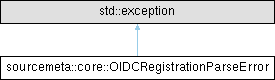
| class sourcemeta::core::OIDCRegistrationParseError |
An error that occurs when parsing an invalid OpenID Connect client registration document.
| struct sourcemeta::core::OIDCIdentity |
The identity a validated ID Token asserts, owning its strings so it outlives the token it was extracted from (OpenID Connect Core 1.0 Section 2).
Public Attributes | |
| std::string | subject |
| std::string | issuer |
| The issuer that produced the token (OpenID Connect Core 1.0 Section 2). | |
| std::optional< std::string > | authentication_context_class |
| std::optional< std::chrono::system_clock::time_point > | authentication_time |
| std::optional<std::string> sourcemeta::core::OIDCIdentity::authentication_context_class |
The authentication context class reference, when present (OpenID Connect Core 1.0 Section 2).
| std::optional<std::chrono::system_clock::time_point> sourcemeta::core::OIDCIdentity::authentication_time |
The time the end user authenticated, when present (OpenID Connect Core 1.0 Section 2).
| std::string sourcemeta::core::OIDCIdentity::subject |
The subject identifier, locally unique and never reassigned at the issuer (OpenID Connect Core 1.0 Section 2).
| struct sourcemeta::core::OIDCValidationOptions |
The OpenID Connect specific checks a Relying Party layers on top of the base JSON Web Token verification when validating an ID Token (OpenID Connect Core 1.0 Section 3.1.3.7).
Public Attributes | |
| std::optional< std::string_view > | nonce |
| std::span< const std::string_view > | acceptable_authentication_context_classes |
| std::span< const std::string_view > | trusted_audiences |
| std::optional< std::chrono::seconds > | maximum_authentication_age |
| std::optional< std::chrono::seconds > | maximum_issued_at_age |
| std::optional< std::string_view > | access_token |
| std::optional< std::string_view > | code |
| bool | require_access_token_hash {false} |
| bool | require_code_hash {false} |
| std::span<const std::string_view> sourcemeta::core::OIDCValidationOptions::acceptable_authentication_context_classes |
The acceptable authentication context class references, checked when non-empty (OpenID Connect Core 1.0 Section 3.1.3.7 step 12).
| std::optional<std::string_view> sourcemeta::core::OIDCValidationOptions::access_token |
The access token to bind through at_hash, verified against the claim when both are present (OpenID Connect Core 1.0 Section 3.1.3.6).
| std::optional<std::string_view> sourcemeta::core::OIDCValidationOptions::code |
The authorization code to bind through c_hash, verified against the claim when both are present (OpenID Connect Core 1.0 Section 3.3.2.11).
| std::optional<std::chrono::seconds> sourcemeta::core::OIDCValidationOptions::maximum_authentication_age |
The maximum authentication age, requiring a fresh auth_time when set (OpenID Connect Core 1.0 Section 3.1.3.7 step 13).
| std::optional<std::chrono::seconds> sourcemeta::core::OIDCValidationOptions::maximum_issued_at_age |
The maximum age of the iat claim, checked when set (OpenID Connect Core 1.0 Section 3.1.3.7 step 10).
| std::optional<std::string_view> sourcemeta::core::OIDCValidationOptions::nonce |
The nonce sent in the authentication request, which the token must echo when supplied (OpenID Connect Core 1.0 Section 3.1.3.7 step 11).
| bool sourcemeta::core::OIDCValidationOptions::require_access_token_hash {false} |
Whether the at_hash claim is required, the case for the implicit and hybrid flows that return an access token from the authorization endpoint. When set, the claim must be present and verified against access_token, which must also be supplied (OpenID Connect Core 1.0 Sections 3.2.2.10 and 3.3.2.11).
| bool sourcemeta::core::OIDCValidationOptions::require_code_hash {false} |
| std::span<const std::string_view> sourcemeta::core::OIDCValidationOptions::trusted_audiences |
The additional audiences beyond the client that the caller trusts. Every aud value that is not the client must appear in this set, so an empty set rejects any additional audience (OpenID Connect Core 1.0 Section 3.1.3.7 step 3).
| struct sourcemeta::core::OIDCIdTokenClaims |
The claims an OpenID Provider mints into an ID Token (OpenID Connect Core 1.0 Section 2). The access token and code, when supplied, are hashed into the at_hash and c_hash claims under the signing algorithm.
Public Attributes | |
| std::string_view | issuer |
| The issuer identifier (OpenID Connect Core 1.0 Section 2), REQUIRED. | |
| std::string_view | subject |
| The subject identifier (OpenID Connect Core 1.0 Section 2), REQUIRED. | |
| std::string_view | audience |
| std::chrono::system_clock::time_point | issued_at |
| std::chrono::system_clock::time_point | expiration |
| The time the token expires (OpenID Connect Core 1.0 Section 2), REQUIRED. | |
| std::optional< std::string_view > | nonce |
| std::optional< std::string_view > | authorized_party |
| std::optional< std::string_view > | authentication_context_class |
| std::optional< std::chrono::system_clock::time_point > | authentication_time |
| The time the end user authenticated (OpenID Connect Core 1.0 Section 2). | |
| std::optional< std::string_view > | access_token |
| std::optional< std::string_view > | code |
| std::optional<std::string_view> sourcemeta::core::OIDCIdTokenClaims::access_token |
The access token to bind through at_hash (OpenID Connect Core 1.0 Section 3.1.3.6).
| std::string_view sourcemeta::core::OIDCIdTokenClaims::audience |
The audience, the client the token is for (OpenID Connect Core 1.0 Section 2), REQUIRED.
| std::optional<std::string_view> sourcemeta::core::OIDCIdTokenClaims::authentication_context_class |
The authentication context class reference (OpenID Connect Core 1.0 Section 2).
| std::optional<std::string_view> sourcemeta::core::OIDCIdTokenClaims::authorized_party |
The authorized party, set when the audience carries more than one value (OpenID Connect Core 1.0 Section 2).
| std::optional<std::string_view> sourcemeta::core::OIDCIdTokenClaims::code |
The authorization code to bind through c_hash (OpenID Connect Core 1.0 Section 3.3.2.11).
| std::chrono::system_clock::time_point sourcemeta::core::OIDCIdTokenClaims::issued_at |
The time the token was issued (OpenID Connect Core 1.0 Section 2), REQUIRED.
| std::optional<std::string_view> sourcemeta::core::OIDCIdTokenClaims::nonce |
The nonce echoed from the authentication request (OpenID Connect Core 1.0 Section 2).
| struct sourcemeta::core::OIDCLogoutRequest |
An RP-Initiated Logout request (OpenID Connect RP-Initiated Logout 1.0 Section 2). Each field is a non-owning view.
Public Attributes | |
| std::string_view | id_token_hint |
| std::string_view | logout_hint |
| std::string_view | client_id |
| The client identifier (OpenID Connect RP-Initiated Logout 1.0 Section 2). | |
| std::string_view | post_logout_redirect_uri |
| std::string_view | state |
| std::string_view | ui_locales |
| std::string_view sourcemeta::core::OIDCLogoutRequest::id_token_hint |
The ID Token previously issued, hinting which session to end (OpenID Connect RP-Initiated Logout 1.0 Section 2).
| std::string_view sourcemeta::core::OIDCLogoutRequest::logout_hint |
A hint about the end user, when no ID Token hint is available (OpenID Connect RP-Initiated Logout 1.0 Section 2).
| std::string_view sourcemeta::core::OIDCLogoutRequest::post_logout_redirect_uri |
Where to redirect after logout, matched against the registered set (OpenID Connect RP-Initiated Logout 1.0 Section 2).
| std::string_view sourcemeta::core::OIDCLogoutRequest::state |
The opaque state echoed back to the client (OpenID Connect RP-Initiated Logout 1.0 Section 2).
| std::string_view sourcemeta::core::OIDCLogoutRequest::ui_locales |
The space-delimited preferred UI locales (OpenID Connect RP-Initiated Logout 1.0 Section 2).
| class sourcemeta::core::OIDCProviderMetadata |
An OpenID Provider metadata document (OpenID Connect Discovery 1.0), owning its JSON. It is a superset of an OAuth authorization server metadata document, validated on construction against the issuer it was retrieved for: the OAuth checks apply, and in addition jwks_uri, subject_types_supported, and id_token_signing_alg_values_supported are REQUIRED and non-empty, and the signing algorithm list must include RS256. A string accessor returns a view into the owned document, valid for the lifetime of this object. For example:
Public Member Functions | |
| OIDCProviderMetadata (JSON &&data, const std::string_view issuer) | |
| OIDCProviderMetadata (OAuthServerMetadata &&oauth) | |
| auto | issuer () const -> std::string_view |
| The issuer identifier (OpenID Connect Discovery 1.0 Section 3). | |
| auto | authorization_endpoint () const -> std::optional< std::string_view > |
| The authorization endpoint (OpenID Connect Discovery 1.0 Section 3). | |
| auto | token_endpoint () const -> std::optional< std::string_view > |
| The token endpoint (OpenID Connect Discovery 1.0 Section 3). | |
| auto | userinfo_endpoint () const -> std::optional< std::string_view > |
| The UserInfo endpoint (OpenID Connect Discovery 1.0 Section 3). | |
| auto | registration_endpoint () const -> std::optional< std::string_view > |
| auto | jwks_uri () const -> std::string_view |
| auto | end_session_endpoint () const -> std::optional< std::string_view > |
| auto | check_session_iframe () const -> std::optional< std::string_view > |
| auto | supports_subject_type (const std::string_view value) const -> bool |
| auto | supports_id_token_signing_alg (const std::string_view value) const -> bool |
| auto | supports_response_type (const std::string_view value) const -> bool |
| auto | supports_token_endpoint_auth_method (const std::string_view value) const -> bool |
| auto | supports_scope (const std::string_view value) const -> bool |
| Whether a scope is supported (OpenID Connect Discovery 1.0 Section 3). | |
| auto | supports_claim (const std::string_view value) const -> bool |
| Whether a claim is supported (OpenID Connect Discovery 1.0 Section 3). | |
| auto | supports_claims_parameter () const -> bool |
| auto | oauth () const -> const OAuthServerMetadata & |
| auto | data () const -> const JSON & |
| The underlying document, for reaching members without a typed accessor. | |
Static Public Member Functions | |
| static auto | from (JSON &&data, const std::string_view issuer) -> std::optional< OIDCProviderMetadata > |
| static auto | from (OAuthServerMetadata &&oauth) -> std::optional< OIDCProviderMetadata > |
| sourcemeta::core::OIDCProviderMetadata::OIDCProviderMetadata | ( | JSON && | data, |
| const std::string_view | issuer ) |
Construct and validate a metadata document for an expected issuer, throwing when it is invalid. The document is moved in.
|
explicit |
Apply the OpenID Connect layer to a document already parsed and validated as OAuth authorization server metadata, throwing when the OpenID Connect requirements are not met. The document is moved in and the OAuth checks are not repeated.
|
nodiscard |
The Session Management check session iframe (OpenID Connect Session Management 1.0 Section 2.1).
|
nodiscard |
The RP-Initiated Logout end session endpoint (OpenID Connect RP-Initiated Logout 1.0 Section 2).
|
staticnodiscard |
Construct and validate a metadata document for an expected issuer, returning no value when it is invalid. The document is moved in.
|
staticnodiscard |
Apply the OpenID Connect layer to a document already parsed and validated as OAuth authorization server metadata, returning no value when the OpenID Connect requirements are not met. This is what a caching resolver hands back, so lifting it costs no reparse and no repeated OAuth validation. For example:
|
nodiscard |
The JWK Set document location, REQUIRED by OpenID Connect (OpenID Connect Discovery 1.0 Section 3).
|
nodiscard |
The underlying OAuth authorization server metadata this document is a superset of, for reaching the OAuth typed accessors.
|
nodiscard |
The dynamic client registration endpoint (OpenID Connect Discovery 1.0 Section 3).
|
nodiscard |
Whether the claims request parameter is supported, absent meaning false (OpenID Connect Discovery 1.0 Section 3).
|
nodiscard |
Whether an ID Token signing algorithm is supported (OpenID Connect Discovery 1.0 Section 3).
|
nodiscard |
Whether a response type is supported (OpenID Connect Discovery 1.0 Section 3).
|
nodiscard |
Whether a subject identifier type is supported (OpenID Connect Discovery 1.0 Section 3).
|
nodiscard |
Whether a token endpoint authentication method is supported, defaulting to client_secret_basic when absent (OpenID Connect Discovery 1.0 Section 3).
| struct sourcemeta::core::OIDCProviderMetadataConfig |
The configuration an OpenID Provider publishes as its metadata (OpenID Connect Discovery 1.0 Section 3), a superset of the OAuth authorization server configuration, each field a non-owning view. An empty scalar and a zero-element array are omitted, and a capability flag is emitted only when it differs from its specification default.
Public Attributes | |
| OAuthServerMetadataConfig | base |
| std::string_view | userinfo_endpoint |
| The UserInfo endpoint (OpenID Connect Discovery 1.0 Section 3). | |
| std::string_view | end_session_endpoint |
| std::string_view | check_session_iframe |
| std::span< const std::string_view > | subject_types_supported |
| std::span< const std::string_view > | id_token_signing_alg_values_supported |
| std::span< const std::string_view > | id_token_encryption_alg_values_supported |
| std::span< const std::string_view > | id_token_encryption_enc_values_supported |
| std::span< const std::string_view > | userinfo_signing_alg_values_supported |
| std::span< const std::string_view > | userinfo_encryption_alg_values_supported |
| std::span< const std::string_view > | userinfo_encryption_enc_values_supported |
| std::span< const std::string_view > | request_object_signing_alg_values_supported |
| std::span< const std::string_view > | request_object_encryption_alg_values_supported |
| std::span< const std::string_view > | request_object_encryption_enc_values_supported |
| std::span< const std::string_view > | claims_supported |
| The supported claims (OpenID Connect Discovery 1.0 Section 3). | |
| std::span< const std::string_view > | acr_values_supported |
| std::span< const std::string_view > | claim_types_supported |
| The supported claim types (OpenID Connect Discovery 1.0 Section 3). | |
| std::span< const std::string_view > | display_values_supported |
| The supported display values (OpenID Connect Discovery 1.0 Section 3). | |
| std::span< const std::string_view > | claims_locales_supported |
| The supported claims locales (OpenID Connect Discovery 1.0 Section 3). | |
| std::span< const std::string_view > | ui_locales_supported |
| The supported UI locales (OpenID Connect Discovery 1.0 Section 3). | |
| bool | claims_parameter_supported {false} |
| bool | request_parameter_supported {false} |
| bool | request_uri_parameter_supported {true} |
| bool | require_request_uri_registration {false} |
| std::span<const std::string_view> sourcemeta::core::OIDCProviderMetadataConfig::acr_values_supported |
The supported authentication context class references (OpenID Connect Discovery 1.0 Section 3).
| OAuthServerMetadataConfig sourcemeta::core::OIDCProviderMetadataConfig::base |
The OAuth authorization server configuration this is a superset of. Its jwks_uri is REQUIRED for OpenID Connect.
| std::string_view sourcemeta::core::OIDCProviderMetadataConfig::check_session_iframe |
The Session Management check session iframe (OpenID Connect Session Management 1.0 Section 2.1).
| bool sourcemeta::core::OIDCProviderMetadataConfig::claims_parameter_supported {false} |
Whether the claims request parameter is supported, default false, so emitted only when true (OpenID Connect Discovery 1.0 Section 3).
| std::string_view sourcemeta::core::OIDCProviderMetadataConfig::end_session_endpoint |
The RP-Initiated Logout end session endpoint (OpenID Connect RP-Initiated Logout 1.0 Section 3).
| std::span<const std::string_view> sourcemeta::core::OIDCProviderMetadataConfig::id_token_encryption_alg_values_supported |
The supported ID Token encryption algorithms (OpenID Connect Discovery 1.0 Section 3).
| std::span<const std::string_view> sourcemeta::core::OIDCProviderMetadataConfig::id_token_encryption_enc_values_supported |
The supported ID Token content encryptions (OpenID Connect Discovery 1.0 Section 3).
| std::span<const std::string_view> sourcemeta::core::OIDCProviderMetadataConfig::id_token_signing_alg_values_supported |
The supported ID Token signing algorithms (OpenID Connect Discovery 1.0 Section 3), REQUIRED, non-empty, and including RS256. The module never advertises none.
| std::span<const std::string_view> sourcemeta::core::OIDCProviderMetadataConfig::request_object_encryption_alg_values_supported |
The supported request object encryption algorithms (OpenID Connect Discovery 1.0 Section 3).
| std::span<const std::string_view> sourcemeta::core::OIDCProviderMetadataConfig::request_object_encryption_enc_values_supported |
The supported request object content encryptions (OpenID Connect Discovery 1.0 Section 3).
| std::span<const std::string_view> sourcemeta::core::OIDCProviderMetadataConfig::request_object_signing_alg_values_supported |
The supported request object signing algorithms (OpenID Connect Discovery 1.0 Section 3).
| bool sourcemeta::core::OIDCProviderMetadataConfig::request_parameter_supported {false} |
Whether the request request parameter is supported, default false, so emitted only when true (OpenID Connect Discovery 1.0 Section 3).
| bool sourcemeta::core::OIDCProviderMetadataConfig::request_uri_parameter_supported {true} |
Whether the request_uri request parameter is supported, default true, so emitted only when false (OpenID Connect Discovery 1.0 Section 3).
| bool sourcemeta::core::OIDCProviderMetadataConfig::require_request_uri_registration {false} |
Whether a request_uri must be pre-registered, default false, so emitted only when true (OpenID Connect Discovery 1.0 Section 3).
| std::span<const std::string_view> sourcemeta::core::OIDCProviderMetadataConfig::subject_types_supported |
The supported subject identifier types (OpenID Connect Discovery 1.0 Section 3), REQUIRED and non-empty.
| std::span<const std::string_view> sourcemeta::core::OIDCProviderMetadataConfig::userinfo_encryption_alg_values_supported |
The supported UserInfo encryption algorithms (OpenID Connect Discovery 1.0 Section 3).
| std::span<const std::string_view> sourcemeta::core::OIDCProviderMetadataConfig::userinfo_encryption_enc_values_supported |
The supported UserInfo content encryptions (OpenID Connect Discovery 1.0 Section 3).
| std::span<const std::string_view> sourcemeta::core::OIDCProviderMetadataConfig::userinfo_signing_alg_values_supported |
The supported UserInfo signing algorithms (OpenID Connect Discovery 1.0 Section 3).
| class sourcemeta::core::OIDCClientMetadata |
An OpenID Connect client registration document (OpenID Connect Dynamic Client Registration 1.0), owning its JSON. It is a superset of an OAuth client registration document, validated on construction: the OAuth checks apply, and in addition redirect_uris is REQUIRED and non-empty, which OpenID Connect tightens from the OAuth OPTIONAL. A string accessor returns a view into the owned document, valid for the lifetime of this object. For example:
Public Member Functions | |
| OIDCClientMetadata (JSON &&data) | |
| auto | has_redirect_uri (const std::string_view value) const -> bool |
| auto | application_type () const -> std::string_view |
| auto | subject_type () const -> std::optional< std::string_view > |
| auto | sector_identifier_uri () const -> std::optional< std::string_view > |
| auto | id_token_signed_response_alg () const -> std::string_view |
| auto | id_token_encrypted_response_alg () const -> std::optional< std::string_view > |
| auto | userinfo_signed_response_alg () const -> std::optional< std::string_view > |
| auto | default_max_age () const -> std::optional< std::chrono::seconds > |
| auto | require_auth_time () const -> bool |
| auto | initiate_login_uri () const -> std::optional< std::string_view > |
| auto | has_post_logout_redirect_uri (const std::string_view value) const -> bool |
| auto | oauth () const -> const OAuthClientMetadata & |
| The underlying OAuth client registration this document is a superset of. | |
| auto | data () const -> const JSON & |
| The underlying document, for reaching members without a typed accessor. | |
Static Public Member Functions | |
| static auto | from (JSON &&data) -> std::optional< OIDCClientMetadata > |
|
explicit |
Construct and validate a client registration document, throwing when it is invalid. The document is moved in.
|
nodiscard |
The application type, defaulting to web (OpenID Connect Dynamic Client Registration 1.0 Section 2).
|
nodiscard |
The default maximum authentication age (OpenID Connect Dynamic Client Registration 1.0 Section 2).
|
staticnodiscard |
Construct and validate a client registration document, returning no value when it is invalid. The document is moved in.
|
nodiscard |
Whether a post-logout redirection URI is registered (OpenID Connect RP-Initiated Logout 1.0 Section 3).
|
nodiscard |
Whether a redirection URI is registered (OpenID Connect Dynamic Client Registration 1.0 Section 2).
|
nodiscard |
The ID Token encryption algorithm (OpenID Connect Dynamic Client Registration 1.0 Section 2).
|
nodiscard |
The ID Token signing algorithm, defaulting to RS256 (OpenID Connect Dynamic Client Registration 1.0 Section 2).
|
nodiscard |
The URI a third party uses to initiate login (OpenID Connect Dynamic Client Registration 1.0 Section 2).
|
nodiscard |
Whether the auth_time claim is always required, defaulting to false (OpenID Connect Dynamic Client Registration 1.0 Section 2).
|
nodiscard |
The sector identifier URI for pairwise subjects (OpenID Connect Dynamic Client Registration 1.0 Section 2).
|
nodiscard |
The subject identifier type (OpenID Connect Dynamic Client Registration 1.0 Section 2).
|
nodiscard |
The UserInfo signing algorithm (OpenID Connect Dynamic Client Registration 1.0 Section 2).
|
strong |
The error codes an authentication endpoint returns in addition to the OAuth authorization error codes (OpenID Connect Core 1.0 Section 3.1.2.6).
|
strong |
The behavioural profile a builder or validator runs under. Strict allows only the Authorization Code flow with PKCE, and Legacy additionally permits the Hybrid code id_token flow, which is weaker and off by default (OpenID Connect Core 1.0 Section 3, the module design Section 14.2). For example:
|
strong |
The subject identifier type an OpenID Provider assigns (OpenID Connect Core 1.0 Section 8). A public subject is shared across clients, while a pairwise subject is distinct per sector so clients cannot correlate the end user.
| SOURCEMETA_CORE_OIDC_EXPORT auto sourcemeta::core::oidc_authorization_url | ( | const std::string_view | authorization_endpoint, |
| const std::string_view | client_id, | ||
| const std::string_view | redirect_uri, | ||
| const std::string_view | state, | ||
| const std::string_view | code_challenge, | ||
| const std::string_view | nonce ) -> std::optional< std::string > |
A convenience for the common authorization code flow authentication request, enforcing scope=openid, response_type=code, and the PKCE S256 method, returning the URL or no value when the request is malformed (OpenID Connect Core 1.0 Section 3.1.2.1). For example:
| SOURCEMETA_CORE_OIDC_EXPORT auto sourcemeta::core::oidc_build_authentication_url | ( | const std::string_view | endpoint, |
| const OIDCAuthenticationRequest & | request, | ||
| std::string & | sink, | ||
| const OIDCProfile | profile = OIDCProfile::Strict ) -> bool |
Build an OpenID Connect authentication request URL from an endpoint and a request, returning whether the request is well formed (OpenID Connect Core 1.0 Section 3.1.2.1). The client_id and redirect_uri are REQUIRED, the scope must contain openid, when prompt carries none it must be the only value, and offline_access cannot pair with a none prompt. The response_type is limited by the profile, which permits the Authorization Code flow by default and additionally the Hybrid code id_token flow under OIDCProfile::Legacy, any flow that returns an ID Token requires a nonce, and OIDCProfile::Strict requires a code_challenge with the S256 method (PKCE). The OpenID Connect parameters are appended to the OAuth authorization query, percent-escaped, and the sink is appended to and never cleared. For example:
| SOURCEMETA_CORE_OIDC_EXPORT auto sourcemeta::core::oidc_build_claims_parameter | ( | const std::span< const OIDCClaimRequest > | userinfo_claims, |
| const std::span< const OIDCClaimRequest > | id_token_claims ) -> JSON |
Build a claims request parameter object requesting the given claims for the UserInfo endpoint and the ID Token (OpenID Connect Core 1.0 Section 5.5). An essential claim is requested with {"essential":true}, and a voluntary claim with null. A target with no claims is omitted. For example:
| SOURCEMETA_CORE_OIDC_EXPORT auto sourcemeta::core::oidc_build_logout_url | ( | const std::string_view | end_session_endpoint, |
| const OIDCLogoutRequest & | request, | ||
| std::string & | sink ) -> void |
Build an RP-Initiated Logout request URL from an end session endpoint and a request (OpenID Connect RP-Initiated Logout 1.0 Section 2). Each present parameter is percent-escaped, an existing query on the endpoint is honored, and the sink is appended to and never cleared. For example:
| SOURCEMETA_CORE_OIDC_EXPORT auto sourcemeta::core::oidc_build_request_object | ( | const JSON & | parameters, |
| const JWKPrivate & | key, | ||
| const JWSAlgorithm | algorithm ) -> std::optional< std::string > |
Build and sign a request object from a set of authentication request parameters, returning the compact JWT or no value when the key cannot produce the signature (OpenID Connect Core 1.0 Section 6.1). The parameters should carry the iss set to the client and the aud set to the OpenID Provider issuer. For example:
| SOURCEMETA_CORE_OIDC_EXPORT auto sourcemeta::core::oidc_build_userinfo | ( | const std::string_view | subject, |
| const JSON & | additional_claims ) -> JSON |
Build a UserInfo response object for the given subject and additional claims, ensuring the REQUIRED sub claim is present (OpenID Connect Core 1.0 Section 5.3.2). For example:
| SOURCEMETA_CORE_OIDC_EXPORT auto sourcemeta::core::oidc_claim_request_accepts | ( | const JSON & | request, |
| const JSON & | value ) -> bool |
Whether an individual claim request permits a value, where the request is the member value a claims request parameter maps a claim name to (OpenID Connect Core 1.0 Section 5.5.1). A null request or one with neither a value nor a values constraint permits any value, comparison is JSON equality over the whole value, and essential has no effect. For example:
| SOURCEMETA_CORE_OIDC_EXPORT auto sourcemeta::core::oidc_claim_request_accepts_multi_valued | ( | const JSON & | request, |
| const JSON & | value ) -> bool |
Whether an individual claim request permits a claim carrying a set rather than a single value, which is the shape the claims that govern access actually arrive in. RFC 9068 Section 2.2.3.1 has an authorization server encode groups, roles and entitlements as the User resource attributes of RFC 7643 Section 4.1.2.
An array is a set the caller belongs to, so any one member satisfying the request satisfies it. A member is either a primitive or a complex object (RFC 7643 Section 2.4), so one list may carry both, and anything else, a nested array among them, is no member shape that section defines and satisfies nothing. A complex member is compared on its value sub-attribute alone, which that section defines as "the attribute's significant value", never on display, which is "a human-readable name, primarily used for display purposes" and so would let whoever can rename a group grant access. A member carrying no value satisfies nothing.
RFC 7643 Section 2.5 holds an unassigned attribute, the null value, and the empty array to be equivalent in state, so none of them carries membership. An empty array, a null claim, a null member, and a complex member whose value is null all satisfy nothing, even where the request constrains nothing and would otherwise permit any value.
Any other value is compared as oidc_claim_request_accepts compares it. For example:
|
noexcept |
The standard scope that requests a claim, or no value when no claim-requesting scope carries it (OpenID Connect Core 1.0 Section 5.4). The sub claim maps to openid, which always returns it (Section 5.3.2), and a scope name is never invented from a non-standard claim name. For example:
| SOURCEMETA_CORE_OIDC_EXPORT auto sourcemeta::core::oidc_claims_parameter_accepts | ( | const JSON & | claims, |
| const std::string_view | target, | ||
| const std::string_view | claim, | ||
| const JSON & | value ) -> bool |
Whether the request for a claim permits the given value for a target member, which is userinfo or id_token (OpenID Connect Core 1.0 Section 5.5.1). A request with neither a value nor a values constraint permits any value, and a claim that is not requested permits none. For example:
| SOURCEMETA_CORE_OIDC_EXPORT auto sourcemeta::core::oidc_claims_parameter_is_essential | ( | const JSON & | claims, |
| const std::string_view | target, | ||
| const std::string_view | claim ) -> bool |
Whether a claims request parameter marks a claim as essential for a target member, which is userinfo or id_token (OpenID Connect Core 1.0 Section 5.5.1). For example:
| SOURCEMETA_CORE_OIDC_EXPORT auto sourcemeta::core::oidc_claims_parameter_requests | ( | const JSON & | claims, |
| const std::string_view | target, | ||
| const std::string_view | claim ) -> bool |
Whether a claims request parameter requests a claim for a target member, which is userinfo or id_token (OpenID Connect Core 1.0 Section 5.5). For example:
| SOURCEMETA_CORE_OIDC_EXPORT auto sourcemeta::core::oidc_claims_parameter_value | ( | const JSON & | claims, |
| const std::string_view | target, | ||
| const std::string_view | claim ) -> const JSON * |
The specific value a claims request parameter asks a claim to have for a target member, which is userinfo or id_token, or no value when none is requested (OpenID Connect Core 1.0 Section 5.5.1). For example:
| SOURCEMETA_CORE_OIDC_EXPORT auto sourcemeta::core::oidc_decrypt_nested_jwt | ( | const std::string_view | compact, |
| const JWKPrivate & | key ) -> std::optional< std::string > |
Decrypt a nested encrypted token, recovering the inner signed JWT from a compact JWE, returning no value when the input is not a valid JWE or the key cannot decrypt it (OpenID Connect Core 1.0 Section 10.2). OpenID Connect encrypted ID Tokens, UserInfo responses, and request objects are a signed JWT wrapped in a JWE, so the Relying Party decrypts first and then verifies the recovered signature. For example:
| SOURCEMETA_CORE_OIDC_EXPORT auto sourcemeta::core::oidc_discovery_url | ( | const std::string_view | issuer | ) | -> std::optional< std::string > |
Derive the OpenID Provider Configuration well-known URL from an issuer identifier, returning no value when the issuer is not a valid identifier (OpenID Connect Discovery 1.0 Section 4.1). Unlike the RFC 8414 form, the well-known string is appended after the issuer path rather than inserted before it. For example:
|
noexcept |
The wire code for an authentication endpoint error (OpenID Connect Core 1.0 Section 3.1.2.6). For example:
| SOURCEMETA_CORE_OIDC_EXPORT auto sourcemeta::core::oidc_front_channel_pairing_is_valid | ( | const std::string_view | issuer, |
| const std::string_view | session_id ) -> bool |
Whether a Front-Channel Logout iss and sid pair is used in a valid combination, which is both present or both absent (OpenID Connect Front-Channel Logout 1.0 Section 3). For example:
|
noexcept |
Whether a name is one of the OpenID Connect standard claims (OpenID Connect Core 1.0 Section 5.1). For example:
| SOURCEMETA_CORE_OIDC_EXPORT auto sourcemeta::core::oidc_make_provider_metadata | ( | const OIDCProviderMetadataConfig & | config | ) | -> std::optional< JSON > |
Build an OpenID Provider metadata document for the well-known endpoint (OpenID Connect Discovery 1.0 Section 3), returning no value when the document would be unusable: the OAuth base is unusable, the REQUIRED jwks_uri, subject_types_supported, or id_token_signing_alg_values_supported is missing or empty, the ID Token signing algorithm list omits RS256 or contains none, or an advertised OpenID Connect endpoint is not a valid https URL. For example:
| SOURCEMETA_CORE_OIDC_EXPORT auto sourcemeta::core::oidc_merge_claims | ( | const JSON & | id_token_claims, |
| const JSON & | userinfo ) -> std::optional< JSON > |
Combine the claims a provider asserted in an ID Token with those its UserInfo endpoint returned about the same person, with no result when the two cannot be established to be about one person. OpenID Connect Core 1.0 Section 5.3.2 requires the UserInfo subject "to exactly match the <tt>sub</tt> Claim in the ID Token; if they do not match, the UserInfo Response values MUST NOT be used", and Section 2 makes that claim required of an ID Token, so a missing subject on either side is refused rather than merged.
Only the ID Token is signed, so its claims stand and UserInfo only fills what it left out. Three groups are exempt from that filling, because their members mean nothing apart from one another:
A claim that is absent, null, or an empty string delivers nothing, those being the shapes Section 5.3.2 names in having an unreturned claim omitted rather than "present with a null or empty string value". Such a claim neither delivers a subject its assertion could speak for, nor blocks the other answer from filling it, nor is itself carried over. Every other value, an empty array or object included, is delivered as it stands, save for the aggregated members, which name and resolve nothing when empty. For example:
| SOURCEMETA_CORE_OIDC_EXPORT auto sourcemeta::core::oidc_mint_id_token | ( | const OIDCIdTokenClaims & | claims, |
| const JWKPrivate & | key, | ||
| const JWSAlgorithm | algorithm ) -> std::optional< std::string > |
Mint and sign an ID Token from a claim set under a signing key and algorithm, returning the compact serialization or no value when the key cannot produce the signature (OpenID Connect Core 1.0 Section 2). The at_hash and c_hash claims are computed and embedded when the access token or code is supplied. For example:
| SOURCEMETA_CORE_OIDC_EXPORT auto sourcemeta::core::oidc_nonce | ( | ) | -> std::array< char, 43 > |
Generate a fresh nonce for an authentication request, an unguessable value bound to the session and returned in the ID Token (OpenID Connect Core 1.0 Section 15.5.2). For example:
| SOURCEMETA_CORE_OIDC_EXPORT auto sourcemeta::core::oidc_pairwise_subject | ( | const std::string_view | sector_identifier, |
| const std::string_view | local_account_identifier, | ||
| const std::string_view | provider_secret ) -> std::string |
Derive a pairwise subject identifier from a sector identifier and a local account identifier, keyed by a confidential OpenID Provider secret (OpenID Connect Core 1.0 Section 8.1). The provider_secret must be kept secret, as a public value would let account identifiers be enumerated from the pairwise subjects. The value is a keyed HMAC-SHA256 over the sector and account, base64url-encoded, so it is stable per client, distinct per sector, non-reversible, and well under the 255 character limit. For example:
| SOURCEMETA_CORE_OIDC_EXPORT auto sourcemeta::core::oidc_parse_authentication_request | ( | const std::string_view | query, |
| std::string & | storage, | ||
| OIDCAuthenticationRequest & | result, | ||
| const OIDCProfile | profile = OIDCProfile::Strict ) -> bool |
Parse the query of an OpenID Connect authentication request at the provider into the result, returning whether it is well formed (OpenID Connect Core 1.0 Section 3.1.2.1). The client_id, redirect_uri, and response_type are REQUIRED, the scope must contain openid, a none prompt must appear alone, an offline_access scope that cannot yield a refresh token, such as one paired with a none prompt, is dropped rather than rejected (OpenID Connect Core 1.0 Section 11), the response_type is limited by the profile, and OIDCProfile::Strict requires a code_challenge with the S256 method (PKCE). Each recognized value is form-decoded, borrowing from the input when it carries no escape and otherwise from the storage arena, which the caller owns and reuses across parses. The result is reset first, then borrows from the input and the storage, so both must outlive it. For example:
| SOURCEMETA_CORE_OIDC_EXPORT auto sourcemeta::core::oidc_parse_id_token | ( | const JSON & | token_response | ) | -> std::optional< std::string > |
Extract the ID Token from a token endpoint response document, returning no value when the id_token member is absent or not a string (OpenID Connect Core 1.0 Section 3.1.3.3). For example:
| SOURCEMETA_CORE_OIDC_EXPORT auto sourcemeta::core::oidc_request_object_pairing_is_valid | ( | const std::string_view | request, |
| const std::string_view | request_uri ) -> bool |
Whether the request and request_uri parameters are used in a valid combination, which is at most one of them (OpenID Connect Core 1.0 Section 6). For example:
| SOURCEMETA_CORE_OIDC_EXPORT auto sourcemeta::core::oidc_scope_to_claims | ( | const std::string_view | scopes, |
| const std::function< void(std::string_view)> & | on_claim ) -> void |
Invoke the callback with each standard claim that the space-delimited scopes request (OpenID Connect Core 1.0 Section 5.4). The openid scope maps to sub, which is always returned (Section 5.3.2), and profile, Email, address, and phone map to their claim sets. A claim requested by more than one scope is reported once. For example:
| SOURCEMETA_CORE_OIDC_EXPORT auto sourcemeta::core::oidc_sector_identifier_contains | ( | const JSON & | sector_document, |
| const std::span< const std::string_view > | redirect_uris ) -> bool |
Whether a fetched sector_identifier_uri document, a JSON array of redirection URIs, contains every registered redirection URI (OpenID Connect Dynamic Client Registration 1.0 Section 5). The OpenID Provider performs this check at registration before accepting a pairwise client. For example:
| SOURCEMETA_CORE_OIDC_EXPORT auto sourcemeta::core::oidc_session_state | ( | const std::string_view | client_id, |
| const std::string_view | origin, | ||
| const std::string_view | provider_browser_state, | ||
| const std::string_view | salt ) -> std::string |
Compute a Session Management session_state value from the client, the client origin, the OpenID Provider browser state, and a salt (OpenID Connect Session Management 1.0 Section 4.2). The value is the base64url of the SHA-256 of the space-joined inputs, a dot, and the salt. For example:
|
noexcept |
The wire name of a subject identifier type (OpenID Connect Core 1.0 Section 8). For example:
| SOURCEMETA_CORE_OIDC_EXPORT auto sourcemeta::core::oidc_token_hash | ( | const std::string_view | token, |
| const JWSAlgorithm | algorithm ) -> std::optional< std::string > |
Compute an OpenID Connect access token hash (at_hash) or authorization code hash (c_hash) for a token and the ID Token signing algorithm (OpenID Connect Core 1.0 Section 3.1.3.6). The token is hashed with the SHA variant the algorithm is defined over, the left-most half of the digest is kept, and that half is base64url-encoded without padding. The digest is selected from the algorithm by table rather than by slicing its name. Returns no value for EdDSA, whose correct digest depends on the signing curve (SHA-512 for Ed25519, SHAKE256 for Ed448) that the algorithm alone does not convey. For example:
| SOURCEMETA_CORE_OIDC_EXPORT auto sourcemeta::core::oidc_userinfo_matches_subject | ( | const JSON & | userinfo, |
| const std::string_view | expected_subject ) -> bool |
Whether a UserInfo response subject matches the ID Token subject, comparing in constant time, the defence against a substituted response (OpenID Connect Core 1.0 Section 5.3.2). For example:
| SOURCEMETA_CORE_OIDC_EXPORT auto sourcemeta::core::oidc_validate_id_token | ( | const JWT & | token, |
| const JWKS & | keys, | ||
| const std::span< const JWSAlgorithm > | allowed_algorithms, | ||
| const std::string_view | issuer, | ||
| const std::string_view | client_id, | ||
| const std::chrono::system_clock::time_point | now, | ||
| const OIDCValidationOptions & | options = {}, | ||
| const JWTClockSkew | clock_skew = {} ) -> std::optional< OIDCIdentity > |
Validate an ID Token against a key set at a given time, returning the asserted identity or no value when any check fails (OpenID Connect Core 1.0 Section 3.1.3.7). The base JSON Web Token verification (signature under a pinned algorithm, issuer, audience, expiration, and skew) runs first, then the OpenID Connect steps: the subject and issued-at are required, every audience beyond the client must be one the caller trusts, an azp matching the client is required when the audience carries more than one value, the nonce is echoed when one was sent, the authentication context and age constraints hold, and a required binding hash is present and matches. The algorithm allow-list is pinned by the caller and must never contain none. For example:
| SOURCEMETA_CORE_OIDC_EXPORT auto sourcemeta::core::oidc_validate_id_token | ( | JWKSProvider & | provider, |
| const JWT & | token, | ||
| const std::span< const JWSAlgorithm > | allowed_algorithms, | ||
| const std::string_view | issuer, | ||
| const std::string_view | client_id, | ||
| const OIDCValidationOptions & | options = {} ) -> std::optional< OIDCIdentity > |
Validate an ID Token against a caching key set provider, returning the asserted identity or no value when any check fails (OpenID Connect Core 1.0 Section 3.1.3.7). The provider supplies the keys, the current time, and the clock skew, and the OpenID Connect steps run against the same clock the signature verification used. For example:
| SOURCEMETA_CORE_OIDC_EXPORT auto sourcemeta::core::oidc_validate_logout_token | ( | const JWT & | token, |
| const JWKS & | keys, | ||
| const std::span< const JWSAlgorithm > | allowed_algorithms, | ||
| const std::string_view | issuer, | ||
| const std::string_view | client_id, | ||
| const std::chrono::system_clock::time_point | now, | ||
| const JWTClockSkew | clock_skew = {} ) -> bool |
Validate a Back-Channel Logout token against a key set at a given time (OpenID Connect Back-Channel Logout 1.0 Section 2.6). The signature is verified under a pinned algorithm, the issuer and audience must match, the iat must be present and not in the future, the exp must be present and not have passed, the typ header when present must be logout+jwt, the token must carry a sub or sid, an events object with the back-channel logout member, a jti, and it must not carry a nonce. Replay rejection by jti is the caller's responsibility. For example:
| SOURCEMETA_CORE_OIDC_EXPORT auto sourcemeta::core::oidc_verify_request_object | ( | const JWT & | token, |
| const JWKS & | keys, | ||
| const std::span< const JWSAlgorithm > | allowed_algorithms, | ||
| const std::string_view | client_id, | ||
| const std::string_view | provider_issuer ) -> std::optional< JSON > |
Verify a request object and return its parameters, or no value when the signature does not verify under a pinned algorithm, the issuer is present but is not the client, or the audience is missing or does not include the OpenID Provider (OpenID Connect Core 1.0 Section 6.1 and Section 6.3). A signed request object must carry an aud that includes the provider, binding it to this provider so it cannot be replayed to another one. For example:
| SOURCEMETA_CORE_OIDC_EXPORT auto sourcemeta::core::oidc_verify_token_hash | ( | const std::string_view | token, |
| const JWSAlgorithm | algorithm, | ||
| const std::string_view | claim ) -> bool |
Whether an at_hash or c_hash claim matches a token under the ID Token signing algorithm, comparing in constant time (OpenID Connect Core 1.0 Section 3.1.3.6). For example:
| SOURCEMETA_CORE_OIDC_EXPORT auto sourcemeta::core::oidc_verify_userinfo | ( | const JWT & | token, |
| const JWKS & | keys, | ||
| const std::span< const JWSAlgorithm > | allowed_algorithms, | ||
| const std::string_view | expected_subject, | ||
| const std::string_view | expected_issuer, | ||
| const std::string_view | expected_client_id ) -> std::optional< JSON > |
Verify a signed UserInfo response and its subject, returning the claims or no value when the signature does not verify under a pinned algorithm, the subject does not match the ID Token subject, or iss or aud is missing or does not identify this provider and client. A signed response MUST carry iss and aud (OpenID Connect Core 1.0 Section 5.3.2, errata set 2), so a signed response lacking either is rejected. Checking aud binds the response to this client, preventing one minted for another client from being accepted here. For example:
| SOURCEMETA_CORE_OIDC_EXPORT auto sourcemeta::core::oidc_webfinger_issuer | ( | const JSON & | descriptor | ) | -> std::optional< std::string_view > |
Extract the issuer from a WebFinger JSON Resource Descriptor, the href of the link whose rel is the OpenID Connect issuer relation and whose value is a valid https issuer identifier, returning no value when none is present (OpenID Connect Discovery 1.0 Section 2). The returned view borrows from the descriptor, which must outlive it. For example:
| SOURCEMETA_CORE_OIDC_EXPORT auto sourcemeta::core::oidc_webfinger_request | ( | const std::string_view | identifier | ) | -> std::optional< OIDCWebFingerRequest > |
Normalize a user-supplied identifier and build its WebFinger issuer discovery request, returning no value when the identifier has no host (OpenID Connect Discovery 1.0 Section 2, 2.1). An acct: identifier and an https URL are kept as the resource, a bare user@host becomes an acct: URI, and any other input is treated as an https URL. For example:
|
noexcept |
Map an authentication endpoint error code to its value, returning no value for an unrecognized code (OpenID Connect Core 1.0 Section 3.1.2.6). For example:
|
noexcept |
Map a subject identifier type name to its value, returning no value for an unrecognized name (OpenID Connect Core 1.0 Section 8). For example:
 1.16.1